Education in the Republic of Korea
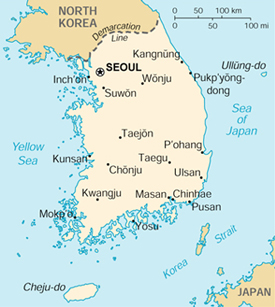 The current higher education system in Korea is derived from both Eastern and Western traditions. After centuries of Confucian influence, the advent of missionaries from Europe and the United States facilitated a shift towards Western-oriented education in the late 1800s. In addition to establishing many colleges and universities in the region, early American missionaries introduced modern scientific curriculum and teaching methods to Korean higher education. However, such influences were temporarily curbed when Korea was formally annexed to the Japanese Empire in 1910.
The new colonial government attempted to control the populace through education and imposed a policy of ‘Japanization’, which — among other things — outlawed the teaching of the Korean language in schools. Higher education was considered superfluous, and practical and vocational training were emphasized instead. Consequently, research and other functions associated with general education suffered greatly. Professional schools, called junmoon hakkyo in Korean, were the most common type of higher education institution during the Japanese occupation.
Korea was liberated from Japanese rule in 1945, but independence came with a heavy price. Following World War II, the Soviet Union and the United States divided the country along the 38th parallel into two nations: the Republic of Korea in the south and the Democratic People’s Republic of Korea in the north. In 1950 the peninsula burst into civil war after the north invaded the south in an attempt to unify the two countries under communist rule. The conflict stymied the development of higher education, and at the war’s end, more than 70 percent of South Korea’s elementary schools had either been completely or at least partially destroyed.
When peace was restored in 1953, the government launched a massive rehabilitation effort, laying the foundation for the country’s current system of higher education.
Beginning in the early 1960s, South Korea achieved rapid economic growth, thanks largely to massive infusions of aid from the United States. The country’s per capita income rose to 13 times the level of North Korea. During this time, many schools and universities were built or upgraded. In 1945 there were only 19 institutions of higher education; by 1994 this number had increased to 295.
Vital Facts and Figures
Location: Southern portion of the Korean Peninsula bordering the Sea of Japan and the Yellow Sea
Land area: 38,381 square miles
Major cities and their population:
• Seoul (capital): 9,891,000
• Busan: 3,664, 000
• Daegu: 2,480,000;
• Incheon: 2,476,000;
• Gwangju: 1,352,000;
• Daejeon: 1,367,000
Total population: Approximately 48 million
Per capita income: US$16,100 (estimated)
Literacy: Around 98 percent
Religions: Christian: 49%, Buddhist: 47%, Confucianist: 3%, other: 1%
Number of students enrolled in higher education: 2,541,659
Number of Korean students studying in US: 45,685 (2000/2001)
South Korea’s system of education is based largely on the American model (six years of primary school, six years of secondary school and four years of college). In other ways, however, it remains very distinct from the American system, as demonstrated by the country’s rigorous college entrance process (see below).
Primary Education
Duration: Ages six to 12 (grades 1 to 6)
Curriculum: Korean, mathematics, moral education, natural science, fine arts, music and physical education
Leaving certificate: None
Secondary Education
Middle School
Duration: Ages 12 to 15 (grades 7 to 9)
Curriculum: Korean, English and mathematics
Leaving certificate: Diploma
High School (Academic)
Entrance Exam: Kodung Hakkyo Iphak Sihom (nationwide preliminary examination)
Duration: Ages 16 to 18 (grades 10 to 12)
Curriculum: During the final two years of high school, students choose to specialize in humanities or sciences
Leaving certificate: Immumgye Kodung Hakkyo Choreup Chung (general high school diploma)
Vocational High School
Entrance exam: Silopgye Kodung Hakkyo Sunbal Chedo (qualifying examination)
Duration: Ages 16 to 18 (grades 10 to 12)
Curriculum: Specialized subjects (agricultural, technical, commercial, fishery and marine, and home economics) as well as general academic subjects.
Leaving certificate: Silopgye Kodung Hakkyo Choreup Chung (vocational high school diploma)
Higher Education
There are seven types of higher education institutions that operate under the auspices of the Korean Ministry of Education:
- Colleges and universities offering four-year degree programs and six-year medical and dental colleges
- Graduate schools
- Teacher colleges
- Junior colleges
- Air and correspondence universities
- Open universities
- Miscellaneous schools (mainly theological or single-purpose institutions)
The Korean Air and Correspondent University was opened in 1972 as a junior college affiliated with Seoul University. It later gained full autonomy and in 1992 began offering four-year bachelor’s degrees.
Open universities offer flexible programs in vocational and technical fields. Two-year programs lead to a diploma; four-year programs to a bachelor’s degree.
The miscellaneous schools category was devised by the Ministry of Education to classify institutions that are highly specialized in the programs they offer. These schools generally do not provide a liberal arts core requirement to meet the standards for accepted undergraduate education in South Korea. Students who graduate from these programs receive a diploma and may be eligible to do graduate work in their fields at some colleges and universities.
Two-year junior colleges are either being upgraded to four-year colleges, merged with four-year institutions or phased out altogether. Currently, the most popular fields of study at the tertiary level are engineering technologies and nursing.
University Higher Education
Entrance Exam
The university entrance system in South Korea is highly competitive and has undergone many changes since the country gained independence from Japanese rule in 1945. Students are selected for admission to an institution of higher education based on the results of the Scholastic Achievement Examination for College Entrance (SAECE).
This score, plus the student’s high school transcript, determines admission. Preparation for the SAECE is a grueling ordeal and it is not uncommon for some families to shell out as much as US$2,000 a month for tutorials outside the classroom to ensure their children’s success on the exam.
Programs and Degrees
Stage 1A: The chonmun taehak chorupchang (associate degree) awarded at junior colleges and special schools after two to three years of study.
Stage 1B: The haksa (bachelor’s degree) is awarded after four to six years of study.
Stage 2: The suksa (master’s degree) is awarded after two or three years of study, following the bachelor’s degree. A thesis and comprehensive exam are required.
Stage 3: The paksa (Ph.D.) requires three or more years of study beyond the master’s level. Candidates must demonstrate fluency in English and one other foreign language, pass on oral exam and write a dissertation.
Non-University Higher Education
Junior vocational colleges offer technical and vocational training and have their own entrance exams. Students from either academic or vocational high schools are eligible to apply for admission to these institutions.
Courses offered: Health education, early childhood education, engineering, arts and textiles
Duration: Two- and three-year programs
Certificate awarded: Certificate of completion
Teacher Education
Primary school teachers are trained at specialized four-year universities called national teachers’ colleges. Graduates are awarded a bachelor’s degree and certification to teach at the primary school level.
Secondary school teachers are taught in the faculties of four-year universities. Certification is awarded to graduates who have completed the required courses of study in education as part of their university program.
| WES Grading Scale | |
| Scale | U.S. Grade Equivalents |
| 90 – 100 | A |
| 80 – 89 | B |
| 70 – 79 | C |
| 60 – 69 | D |
| 0 – 59 | F |
For a list of higher education institutions in South Korea go HERE
Sources
- Asian Higher Education: An International Handbook and Reference Guide. 1997. Edited by Gerard Postiglione and Grace Mak. Greenwood Press, USA.
- British Council. 1996. International Guide to Qualifications in Education. Great Britain.
- Higher Education in Korea: Tradition and Adaptation. 2000. Edited by John Weidman and Namgi Park. Falmer Press, USA.
- National Office of Overseas Recognition. 1991. “Country Education Profiles: Republic of Korea.” Australia.